
Application
Review this read-only version for questions and materials needed to submit your solution.

Thank you for participating in the Building the Future Workforce Challenge!
The Caterpillar Building the Future Workforce Challenge aims to identify and test adaptive and tech-forward solutions that will address today’s and tomorrow’s advanced manufacturing and industry technician skill gaps. A core requirement of any solution is that it remains relevant amid evolving technology—ensuring that breakthrough innovation and human potential rise together.
Please read all requirements for this application before you begin and review the resources, Rules and FAQ, as well as the scoring rubric that defines a strong proposal and will be used to assess all valid applications.
This application form saves automatically, and the status of your application is available to view on your dashboard. You have the option to request an automated confirmation email after clicking Submit – be sure the checkbox is clicked to opt into this email when the confirmation message appears.
You understand and agree that your submission may be shared with five of your fellow applicants as part of Peer-to-Peer Review, five Evaluation Panel members, the Selection Committee, and the Building the Future Workforce Challenge team during the evaluation process. You also understand and agree that portions of your applications may be published online and may be shared with the general public to promote your proposal or to highlight results. Those portions may include, but are not limited to: Lead Organization, Lead Organization Website, Solution Title, Solution Statement, Executive Summary, Video Pitch, and Solution Description.
Responses to this submission form must be in English. This provides consistency across all submissions during our review process and reduces the risk of misinterpretation or translation error.
Prior to submission:
- Confirm the information provided on the Registration Form is correct (go to Submissions and select Registration Form).
- Be sure to review your submission as it will appear after it has been submitted (click Preview next to Submit).
- When you have completed all requirements, you will be able to submit the application form. Once you have submitted, you will no longer be able to make changes.
Submit your application no later than 5:00 p.m. U.S. Eastern Time on Tuesday, August 25, 2026. Contact us with questions or technical issues.
All fields are required unless otherwise noted.
A. Quick Pitch
The Building the Future Workforce Challenge seeks to identify, test, and scale tech-forward solutions that will address today’s and tomorrow’s advanced manufacturing and industry technician skill gaps. A core requirement of any solution is that it remains relevant amid evolving technology—ensuring that breakthrough innovation and human potential rise together.
Make a strong first impression with a succinct and compelling overview of your solution. In this section, avoid using first-person language, acronyms, jargon, or complex language that may be difficult for the general public to comprehend. Your responses to this section may be shared publicly in a variety of online settings.
Solution Title (up to 10 words)
Provide a title for your proposed solution that easily identifies and distinguishes it from others.
Solution Statement (up to 25 words)
Provide a short, one- to two-sentence description of your proposed solution.
Executive Summary (up to 75 words)
Provide a concise summary of the most compelling aspects of your proposed solution. This should be a stand-alone statement of the problem, solution, and intended results. It should not require any other context to clearly explain what you are seeking to accomplish.
B. Video Pitch
You are required to submit a video that captures your solution and describes why it should be funded. The video is an opportunity to showcase your vision and pitch your story in a succinct format that is different from the written proposal. This DOES NOT need to be a professionally produced video—a video shot on a smartphone is acceptable.
To complete this requirement, upload a digital film using YouTube (learn more about uploading a YouTube video here). Video submissions must follow these guidelines or else it will render the application ineligible:
- Ninety (90) seconds in length maximum.
- In English, or if in another language, subtitled in English.
- Must be captioned. See information about automatic captioning for YouTube videos here.
- Excludes images, names, and voices of children (persons under age 18).
- Excludes third-party copyrighted material (including, but not limited to, music and photos) for which you do not have a license.
- Set the Privacy Settings on your video to Public or Unlisted—do not set them to Private. When setting as Unlisted, only those with the URL—such as the Building the Future Workforce Challenge team, the Evaluation Panel members, and the Selection Committee—will be able to access and view the video.
- Check to make sure embedding is turned on.
- Be sure all these settings are in place throughout the duration of the competition.
- Comply with YouTube’s terms and conditions.
Here are general suggestions for delivering a high-quality video pitch:
- Introduce yourself and your organization(s) or team.
- Explain your solution, its impact, and what is unique about the way it addresses the problem.
- Describe how you plan to measure success and achieve meaningful results. Do not simply read a slide deck – instead, make an effort to connect with your audience of Peer Reviewers and Evaluation Panel judges.
Paste the YouTube URL in the box below. [YOUTUBE URL BOX, 100 seconds maximum]
C. The Team
Provide information on the leadership, structure, and capabilities of those working on this solution. Should you receive funding, you must designate a Lead Organization responsible for taking accountability for those award funds, as well as providing sustained project direction, control, and supervision. The Lead Organization was identified during registration. If the Lead Organization has changed, please select Registration Form from the Submissions menu to update the Lead Organization information.
Team Type
Select one option that best describes your team for your proposed solution.
- Start-up or early-stage organization
- New partnership led by a start-up or early-stage organization
- Existing organization and/or existing partnership
- New partnership led by an existing organization
Partners
We welcome applications from teams that include multiple organizations and reflect cross-sector collaborations. If your team consists of two or more organizations, list them using the legal name of each organization and the city, state/province, and country they are located (such as Partner Name (Hosur, India). Note: By listing an organization below, the Lead Organization confirms it has conducted due diligence on the listed organization(s) and takes accountability for the disbursement and management of any subgrants should the Lead Organization receive an award from this challenge.
If your team does not consist of two or more organizations, enter “Not applicable” under Key Partner #1 below.
Key Partner #1:
Key Partner #2-5: OPTIONAL
Team Structure (up to 200 words)
Describe the roles, responsibilities, and contributions of each key team member/partner. Explain how the team will work together, including any reporting structures between the partners and Lead Organization. If relevant, include details about how and why the collaboration was formed.
Track Record & Capabilities (up to 200 words)
Describe the past success of your team, and explain how your team is uniquely positioned with the right capabilities, capacity, experience, technical expertise, and commitment to execute your project, particularly in selected Caterpillar facilities or Caterpillar communities given winning solutions will be tested there. Be sure to include core competencies and how they apply to your project, any relevant past endeavors or experience (including with each other), and any other additional details that support your ability to deliver results.
Biographies (up to 150 words)
Introduce us to at least one and up to three individuals who will oversee and be responsible for the success of the project. For each, provide a first/last name, title, and affiliation (if applicable), and a brief biographical statement. Emphasize the expertise and/or credentials that are most relevant to this project.
D. The Problem
Here is your opportunity to more fully explain the problem you intend to solve. Be sure to review our resources for guidance and helpful information as you frame the problem and your approach.
Problem Statement (up to 200 words)
Set the stage for your solution and explain why you are committed to solving one or more of the problem statements for the broader manufacturing and technician industry. Describe the problem as it relates to your proposed approach to build a stronger current and future workforce in the manufacturing sector in the face of rapid advances in technology, and the specific barriers and issues your solution will address.
Existing Landscape (up to 150 words)
Briefly describe other organizations or solutions that are most similar to your work. Explain how your team and proposed solution fit into this landscape and differentiates itself from other organizations or solutions.
E. The Solution
Illustrate your approach and who will use, and benefit from, your proposed solution. Emphasize how your solution aligns with the criteria used to assess each valid application (see scoring rubric).
Solution Categories
Select the relevant categories that are addressed by your proposed solution. These categories are described on our website. Note: Your primary solution category was selected as part of registration – below you may select all that apply. If the primary solution category has changed, please select Registration Form from the Submissions menu to update this information.
- Build interest and awareness of advanced manufacturing and industry technician careers: Shift perceptions among students, teachers, parents, and/or other key influencers by showcasing the opportunities available in modern manufacturing and technician careers
- Prepare new workforce entrants for “day one” success: Implement flexible, sustainable solutions that keep pace with technology and industry needs, enabling learners to arrive job‑ready and increasing the likelihood of retention
- Upskill and reskill the current manufacturing and industry technician workforce: Expand career pathways and mobility by implementing flexible, sustainable solutions that keep pace with technology, enabling current employees to build new technical and leadership capabilities
Solution Description (up to 250 words)
Describe your solution and how it will support training for the advanced manufacturing and industry technician workforce. Illustrate the overall vision of success for your solution, highlighting how it will address today and tomorrow’s advanced manufacturing and industry technician skill gaps by remaining relevant amid evolving technology. Introduce key users and stakeholders.
Innovation & Relevance (up to 200 words)
Explain how your proposed solution will remain relevant—by being nimble and responsive—as technologies and workplaces rapidly evolve in the short and long term. Highlight the unique or innovative technologies, technical features, and creative approaches that address persistent "stickiness” in responding quickly to technological change. Clarify how your approach improves upon, diverges from, enhances, and/or reinforces current methods and practices.
Scalability (up to 200 words)
Share your vision, specific plans, and key factors to successfully scale, replicate, adapt, and/or expand your solution more broadly across the advanced manufacturing and industry technician ecosystem. Realistically describe any challenges or barriers to scale. Explain how testing your solution in collaboration with a large company can make a difference in the success and scale of your solution. Note: While cross‑country replicability is preferred, the Building the Future Workforce Challenge team recognizes this may not always be feasible due to differences in policy, culture, and other factors. Transformative solutions will not be penalized for scalability if they can only be replicated within one country. More information about scalability can be found on our website.
Sustainability (up to 200 words)
Describe how your solution will achieve long‑term sustainability by generating a return on investment (ROI) sufficient to phase out reliance on grant funding. Outline your exit strategy from grant funding, the expected ROI, and articulate how the project will evolve to sustain its value and impact over time. If relevant, discuss how your solution could serve as a model for manufacturing and other industries.
Critical for Success (up to 100 words)
Describe any other critical elements for success, such as technical assistance, staffing needs, etc.
Project Visual (up to three pages)
Upload a single PDF that includes a visual representation of your proposed solution. This may include, but is not limited to illustrations, schematics, images, graphs, diagrams, maps, organizational charts, or other visuals to help reviewers to better understand your team and the proposed approach.
The PDF should not exceed 10 MB and a total of three pages and should not contain lengthy text explanations or be used to circumvent word counts in this application. Some brief labels and/or basic text descriptions are permitted. Any pages beyond the three-page limit and unrelated content to this question will render the application ineligible.
F. Users & Beneficiaries
Describe where and how you will adapt and integrate your proposed solution into Caterpillar communities.
Current Locations (up to 200 words)
Describe past and current locations, industries, and/or sectors where you and/or your team have already implemented and/or are currently operating your solution, highlighting any communities relevant to the Challenge. Provide any context that may clarify the locations in which your solution is or will be available in the near future.
Solution Location(s)
The testing, evaluation, monitoring and/or assessing the feasibility, viability or implementation potential of winning solutions will occur in select Caterpillar facilities or Caterpillar communities. Select all locations where you would like such testing, evaluation, monitoring and/or assessing the feasibility, viability or implementation potential of your proposed solution to occur during the project period. Proposed solutions must be tested and implemented in the following locations, and this is further described on the challenge website. Note: You selected a primary location during registration – below you may select all that apply. If the primary location has changed, please select Registration Form from the Submissions menu to update this information.
- US - Midwest
- US - Northeast
- US - South
- US - West
- Brazil - Campo Largo
- Brazil - Curitiba
- Brazil - Hortolandia
- Brazil - Piracicaba
- Brazil - Sete Lagoas
- India - Aurangabad
- India - Hosur
- India - Tiruvallur
- Mexico - Acuna
- Mexico - Monterrey
- Mexico - Reynosa
- Mexico - San Luis Potosi
- Mexico – Tijuana
- Mexico - Torreon
Location Status
Select one option below that best indicates your past or current presence and capacity in the location(s) selected above. Under Solution Location Description below, you will describe your readiness to test and implement your proposed solution in your selected locations. Select one.
- Headquarters or branch / office based in location(s) with past / current implementation of solution or related activities
- Key staff or team members based in location(s) with past / current implementation of solution or related activities
- One or more key partners based in location(s) with past / current implementation of solution or related activities
- Past / current implementation of solution or related activities in similar location
- None of the above
Solution Location Description (up to 200 words)
The testing, evaluation, monitoring and/or assessing the feasibility, viability or implementation potential of winning solutions will occur in select Caterpillar facilities or Caterpillar communities. Describe why your proposed solution is a strong fit to test and implement within the location(s) selected above. Illustrate your capacity, knowledge, experience, and understanding of the community(ies) and local conditions that support your plans and help ensure your success. Be sure to include any parameters, requirements, regulations, key conditions, environmental factors, and other facility-specific considerations for success. Learn more on the challenge website.
Integration (up to 200 words)
Demonstrate how you’ll build upon and integrate your proposed solution within existing systems and infrastructure in one or more Caterpillar communities during the project period. Further illustrate your understanding of the current local conditions and business environments where you have chosen to implement your solution, including currently relevant realities of training, labor markets, systems, laws and government regulations, and conditions which affect your plans. Address issues that might concern stakeholders, such as cost, implementation, and effects on productivity. Show that you’ve taken time to understand specific issues that are important and/or unique to your prioritized workplaces and stakeholders.
Stakeholder Engagement (up to 150 words)
To be effective, solutions may need support or partnership from others—investors, technology partners, industry leaders, trade associations, etc. Demonstrate your understanding of the key stakeholders necessary for your work to be effective and describe plans to engage with them and exchange feedback on an ongoing basis to ensure scale and long-term success. Articulate any costs/burdens that stakeholders may be expected to absorb.
User Description (up to 200 words)
Identify the user group(s) you have prioritized during the maximum two-year project period, and any secondary or other populations who may benefit from the solution. Be sure to explain how and why your proposed solution is relevant to Caterpillar communities and how your approach responds to existing and expected needs of these communities.
User Journey (up to 200 words)
Describe the journey for up to three (3) different types of potential users of the proposed solution, such as an assemblist, a machinist, a maintenance technician, an industry technician, or an internal or external training provider. This may include the main flow of actions for primary users/intended audiences, as well as other illustrative use cases the solution can support.
User Experience Visual (up to two pages)
Upload a single PDF that visually represents the user experience described above. The PDF should not exceed 10MB and a total of two pages and should not contain additional text explanations or be used to circumvent word counts in this application. Some brief labels and/or basic text descriptions are permitted. Any pages beyond the two-page limit and unrelated content to this specific question will render the application ineligible.
G. Monitoring & Evaluation
Describe what success looks like and demonstrate how your solution will deliver results, highlighting supporting data and/or evidence.
Metrics (up to 250 words)
Describe specific, measurable goals, metrics, and outcomes you aim to achieve during the maximum two-year project period and the timeline to achieve results, including any milestones that serve as a prerequisite to proposed outcomes. Be sure to include metrics that quantify the outcomes resulting from your proposed work, including measures of sustainability.
Evaluation Plan (up to 200 words)
Outline your measurement, evaluation, and learning (MEL) plan during the project period for the metrics you described above and the methodology that you will employ for measuring key outcomes and overall performance of the proposed solution. Describe the means through which you will track results or milestones to indicate success, highlighting any stakeholder collaboration required as part of the evaluation plan.
Solution Stage
Select one option that best describes the existing evidence base for your solution. Note: Eligible, strong proposed solutions will have clear evidence of effectiveness. Review resources and scoring rubric to learn more.
- Validated concept: Early‑stage idea that has undergone testing or review, producing initial evidence that the approach is effective and worth further development
- Proof of concept: Solution tested on a small scale with internal evaluations or outcomes assessments that demonstrate feasibility in real‑world or controlled environments
- Validated Solution: Solution with demonstrated effectiveness, supported by measurable outcomes and consistent performance across multiple settings or implementations
- Ready to Scale: Proven solution with strong internal and external evidence indicating it is prepared for broader, large‑scale implementation with fidelity
- Operating at Scale: Mature solution that is widely deployed, supported by established external assessments of impact, and benefiting from ongoing iteration to further strengthen outcomes
Evidence of Effectiveness (up to 200 words)
Provide evidence to show that the solution has worked and will work. Present any internal (e.g., informal studies, observations, or other indicators of change) or formal evidence, including any evaluation results. Be sure to include results from past/current work with Caterpillar, if applicable.
If you do not have evidence of impact of your solution in the advanced manufacturing or industry technician space, explain how the evaluation results from your solution apply to this space. You may also point to research-backed practices on which your solution is based, or analogous solutions achieving meaningful impact that you think your solution may similarly achieve. Note: You may include a bibliography below under Citations.
Citations (up to 150 words)
If you include citations throughout this application, provide a bibliography with a corresponding bracketed number [#] for each citation. There is no specific format required for citations. You may also offer a list of resources that may be used to validate general claims made in your application. If not applicable, enter “Not applicable.”
H. Project Plan & Budget
Illustrate your plan and the resources required to successfully implement your solution.
Project Plan & Timeline (up to 250 words)
Based on our proposed phases, elaborate on your plans and activities to test and scale your proposed solution over the course of a maximum two-year project period, including the timeline for expected results. Awards are expected to be announced in early 2027, so applicants may use March 2027 as the start for the purposes of this application. Highlight how your plans fall within the specific parameters, requirements, key conditions, environmental factors, and other considerations for success mentioned under Solution Location Description above. You may include phases and/or quarterly or monthly key activities and milestones.
Risk Mitigation (up to 150 words)
Describe the main risks for your solution, as well as any unintended consequences, and your plan to mitigate them. Discuss your experience and capacity to manage technical and/or operational barriers.
Communications (up to 150 words)
Briefly describe your plans to work with Caterpillar to promote your solution and/or share your results, key findings, lessons learned, and other helpful information with others. Provide examples of how you’ve done this in the past.
Budget Narrative (200 words)
Offer a general overview of how you will use the $1 million award, including projected needs by category, expenses by key phase and by year 1 or year 2 of the maximum two-year project period, and the portion of the budget that is expected to be spent on indirect costs. You may include any explanations of existing resources you have already secured.
Budget
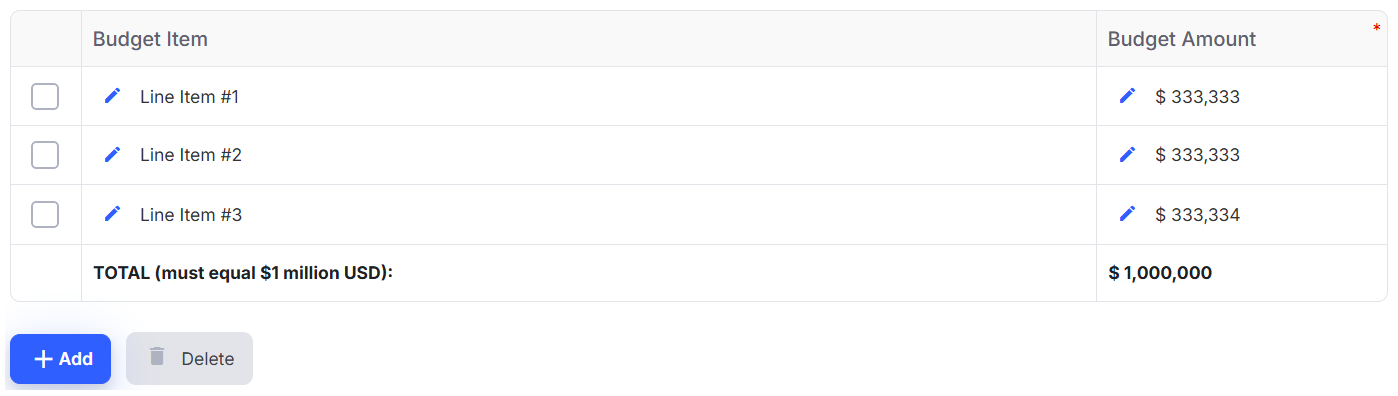
Provide a detailed budget for the $1 million award. Designate year 1 and year 2 of the project period for each line-item description. Funds listed in this table should reflect and clarify the Budget Narrative above, include more detailed cost categories that support your plans and intended outcomes, and adhere to the guidelines listed below.
DIRECT COSTS: Expenses related to implementing, evaluating, and achieving impact and KPIs for proposed solution
- When listing salaries for program staff directly responsible for solution implementation and achieving impact and KPIs, list each job position on the table with job title, percent time dedicated to program and amount of full salary, such as Y1: Assistant Instructor @ 25% time (full salary / benefits = $50,000).
- Do not include staff member names.
- Travel directly related to program delivery is an eligible direct cost.
INDIRECT COSTS: Expenses that are not directly attributable to the proposed project but are necessary for implementation, such as overhead costs needed to indirectly support the program and staff who support the program but are not directly involved with KPIs. We will consider paying for these indirect costs up to a maximum of 20% of direct project or activity costs, and we reserve the right to review and adjust the amounts allocated for indirect expenses.
- When listing salaries for staff who are not directly involved with solution implementation and achieving impact and KPIs, list each position on the table with job title, percent time dedicated to program and amount of full salary, such as Y2: Indirect costs – Finance Officer @ 10% time (full salary / benefits = $50,000).
- Do not include staff member names.
- Travel for support purposes is an eligible indirect cost.
- Monitoring and evaluation expenses related to internal quality control are eligible indirect costs, and must be included as a separate line item, if applicable, such as Y1: Indirect costs – MEL internal quality control
Review the Rules for more information about ineligible expenses and indirect costs.
The budget must account for the full $1 million award. Only include line items with a dollar amount greater than $0. Up to 50 line items may be entered and each description field has a maximum of 25 words.
Total Projected Cost
List the estimated total cost (in US dollars) to implement your solution over a maximum two-year period. The total cost listed must be at least $1 million and, if applicable, this may be more than the $1 million (USD) award.
Contingency & Financial Sustainability (up to 150 words)
If the Total Projected Cost listed above is more than $1 million, explain how you have secured (or plan to secure) the balance of necessary funds and provide an overview of how those funds will be used. You may also describe any potential to leverage additional resources to realize, sustain, and/or scale your project.
Other Project Financing (up to 150 words)
List key funders for the proposed solution and include the financing type (debt, equity, local/state/federal government grant, events/other, in-kind), year financing was received, and amount of financing secured to date. Also include the total amount of dollars secured to date for the proposed solution. If there are no current commitments for the solution, enter “Not applicable.”
Additional Award (up to 150 words)
Should you receive a $1.5 million award from Building the Future Workforce Challenge for the two-year project period, summarize the changes and adjustments you would make to the plans, budget, outcomes, deliverables, and any other key components of your proposed solution.
Other Considerations (up to 100 words)
This is your opportunity to raise any other considerations, emphasize or expand upon a previous point, or provide new information, as necessary. Note: Evaluators are instructed to avoid online research and/or review of links that may be provided as part of this submission – we recommend you include any key considerations and important information within your responses to this application form.
I. Administrative Information
Provide additional information about the Lead Organization.
Country – Lead Organization Identification Number
The Lead Organization must be incorporated in an appropriate jurisdiction. Typically, an identifying number is provided upon incorporation. Select the Country and Identification Type of number that the Lead Organization has been provided.
- United States: Employer Identification Number (EIN)
- Australia: Australia Business Number (ABN)
- Brazil: CNPJ (for companies)
- Canada: Revenue Agency Business/Registration Number
- India: FCRA Registration Number
- Netherlands: KVK Number
- South Africa: Nonprofit Organization Number
- United Kingdom: Charity Number
- United Kingdom: Company Number
- OTHER. Enter name of country
Lead Organization Identification Number (up to 10 words)
Based on your selection above, enter the associated identification number for the Lead Organization. If you selected OTHER and your country does not provide an identification type of number, please enter “Not Applicable.” If this is in progress, insert “Pending approval by [DATE].”
References
Enter the name and contact information for your two references below. References should be from individuals with knowledge of and experience with your relevant work and can comment on the merit of your proposed solution. Note: This information will not be shared during Peer-to-Peer Review and Evaluation Panel Review. These individuals should be prepared to be contacted in late fall 2026 should you advance to the final stage of the challenge.
Reference #1-2
First and Last Name
Title and Organization
Phone
Background. Briefly describe their professional background and the nature of your relationship.
Annual Operating Budget
What is the annual operating budget (USD) of the Lead Organization? Select one.
- Less than $1 Million
- $1.0 to 5.0 Million
- $5.1 to 10 Million
- $10.1 to 25 Million
- $25.1 to 50 Million
- $50.1 to 100 Million
- $100.1 to 250 Million
- $250.1 to 500 Million
- $500.1 to 750 Million
- $750.1 Million to $1 Billion
- $1 Billion +
Intellectual Property (up to 100 words)
Explain any issues related to intellectual property (IP) that underlies your solution. Identify owner(s) of the IP. If you are using existing or off-the-shelf technology, detail the permissions you secured to use that technology. Describe how you will make the use of any IP for the purpose of scaling your proposed solution during the two-year project period. If not applicable, enter “Not applicable.”
Charitable Purpose & Private Benefit (150 words)
Describe the charitable purpose of your project and how the public or a subset, which is a charitable class, will benefit from your project. A charitable class must generally be an indefinite number of individuals who are the subject of the charitable purpose and not a limited number of specified individuals. Briefly explain any private interests (such as shareholders, for-profit companies, contractors, consultants, other individuals) who will benefit more than incidentally from the project as compared to the public or charitable benefit. If your project will trigger any private benefit to one or more individuals, provide an explanation of how the public benefit cannot be achieved without necessarily benefiting those individuals and to what degree any private benefit compares to public benefit. If your project will not benefit any private interests, please explain. Consult with your organization’s leadership, legal, and/or tax professionals as needed.
Lobbying & Electioneering Activities Acknowledgement
Grant funds awarded under this challenge may not be used for lobbying or electioneering purposes or activities. By checking this box, you acknowledge and agree that there is no lobbying or electioneering activity related to the proposed scope of work.
- Project does not involve lobbying or electioneering
Financials
If you are selected to participate in future phases of the competition, we may require information necessary to understand the financial health of the Lead Organization. The Building the Future Workforce Challenge team may request audited financial reports, IRS Form 990’s, and/or certified financials for the past two (2) years.
Provide confirmation that you will be able to provide this information should you be selected to participate in the final stages of this challenge.
- Yes, the Lead Organization can provide financials if selected
J. Additional Information
If your team is invited to participate in any future phases of this competition, you may be asked to provide additional information (refer to the Rules and Timeline), including but not limited to:
- Your acceptance of a separate award agreement with Caterpillar
- Additional information about your organization
- A more detailed budget, project plan, and/or project timeline
- Additional information about charitable purpose and compliance with private benefit rule
- Fully executed Memorandum of Understanding (MOU) with any partners
- Tax determination letter, if applicable
- Audited financial statements, IRS Form 990s, and/or certified financials
- Articles of Incorporation, Charter, or similar documentation
- Evidence of efficacy of the solution, including technical capabilities if applicable
- Evidence of additional funding and resources secured to implement the proposed solution
- Existing policies, if any, addressing conflicts of interest, whistleblower, internal controls, anti-money laundering, intellectual property, code of conduct, ethics, gifts, and any similar policies governing the Lead Organization and/or partners
The Building the Future Workforce Challenge team reserves the right to perform background checks on key individuals associated with the proposal, and the refusal by key individuals to provide necessary authorizations will be a reason to reject any application for further consideration. Background information and the results of any background checks will be kept confidential.